
Should You Back Horses on Soft or Heavy Ground, or Are These Races Best Avoided?
One of the first things many experienced punters check when looking through the day’s racing isn’t the runners, the form or even the betting prices. It’s the going.
And when they see ‘Soft’, ‘Heavy’ or perhaps ‘Soft, Heavy in Places’, some will immediately decide that today’s racing isn’t for them.
Others will see exactly the opposite – an opportunity to find horses that are particularly well suited to the conditions.
So who’s right?
Well, there’s a good argument for both approaches, and understanding the advantages and disadvantages of betting on soft ground can make a considerable difference to how you assess a race.
Why Soft Ground Changes Everything
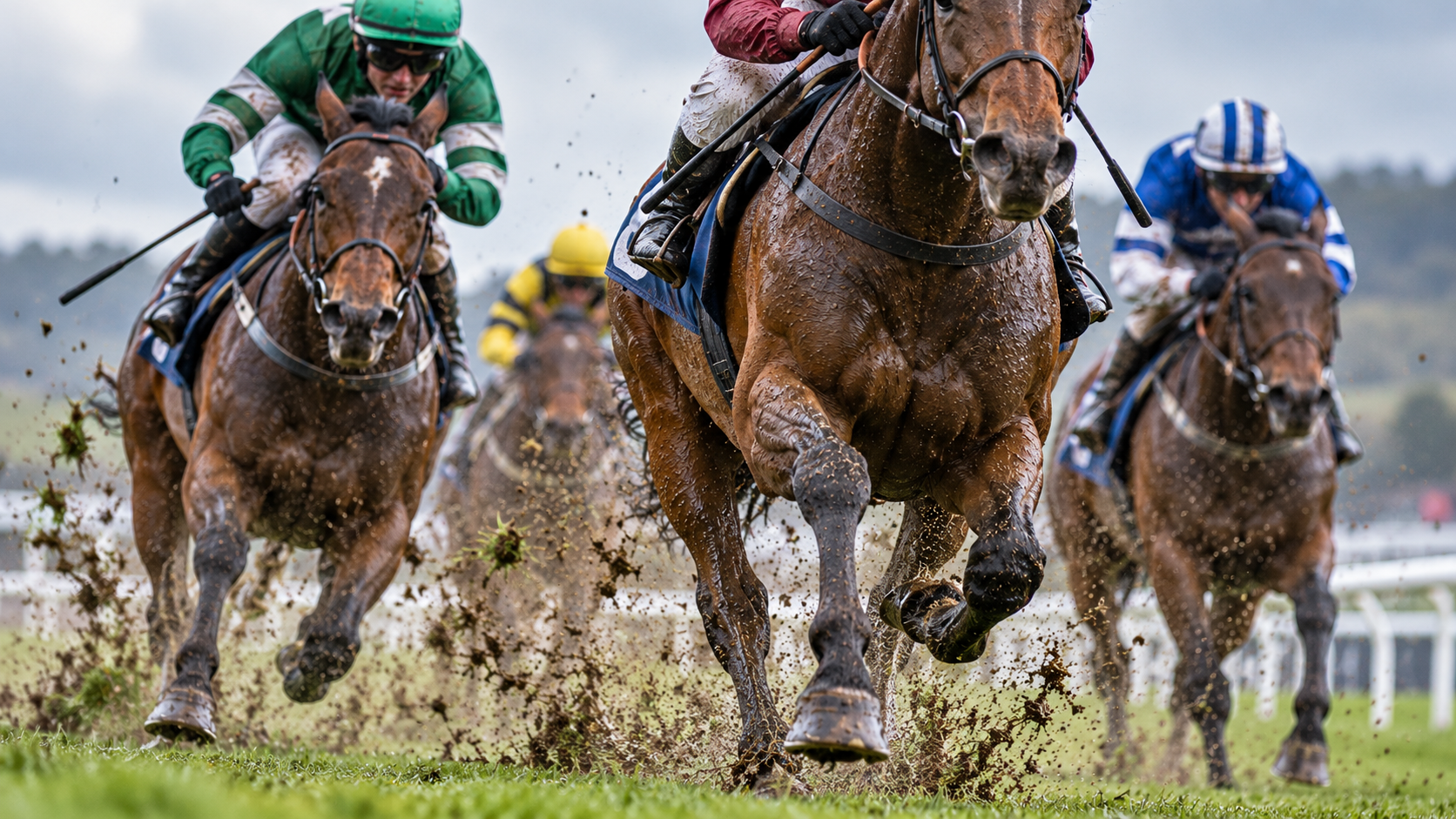
When the ground becomes soft, horse racing can be a very different test.
On good or good to firm ground, horses can generally travel more efficiently and maintain their speed with less effort. But as the ground becomes softer, every stride can require more energy.
Some horses cope with this remarkably well. They maintain their action, travel comfortably and seem almost unaffected by conditions that leave others struggling.
Other horses simply don’t handle it.
A horse that travels beautifully on good ground might struggle to pick up when asked to quicken on soft. Another that looks fairly ordinary on a sound surface can suddenly become a much more competitive animal when the rain arrives.
This is why the going can have such an influence on the result of a race. It isn’t necessarily that one horse has become better overnight, but that the conditions have changed how effectively each runner can use its ability.
And that’s where the opportunities begin.
The Argument for Betting on Soft Ground
Let’s imagine a twelve-runner handicap in which the going has changed from good to soft following overnight rain.
Several runners have produced their best performances on good or faster ground. A couple have never raced on soft, while another three have previously struggled when conditions became testing.
But one horse has won twice on soft ground and produced several of its best speed ratings under similar conditions.
Immediately, that horse becomes interesting.
If the others are unable to reproduce their usual level of performance, the proven soft-ground horse may have a much better chance than its recent finishing positions suggest.
This is one of the strongest arguments for betting when the ground becomes testing. You may be able to eliminate some of the opposition, or at least question whether they’re likely to perform to their usual standard.
And remember, you don’t necessarily need to find a horse that improves on soft ground. Sometimes simply finding one that performs to its normal ability while others underperform is enough.
There can also be opportunities with horses returning to their preferred conditions.
Perhaps a horse has been running disappointingly throughout the summer on good to firm ground. Its handicap mark has gradually fallen, its recent form figures look unattractive and it has slipped down the betting.
Then the autumn rain arrives.
Suddenly it’s racing on the same soft ground on which it previously won from a considerably higher handicap mark.
That is exactly the type of horse worth investigating. The market may have concentrated on its recent disappointing performances, while the return to suitable conditions provides a perfectly reasonable explanation for why it could run much better today.
But How Soft Is Soft?
Now we come to the other side of the argument, and this is where things become considerably more complicated.
We tend to talk about the going as though it’s an exact measurement. Good. Good to Soft. Soft. Heavy.
But those descriptions cover a surprisingly wide range of conditions.
Soft ground at one racecourse isn’t necessarily the same as soft ground at another. Different soil types, drainage systems, weather patterns and course maintenance can all affect how a racing surface behaves.
A horse that handles soft ground at Newbury might not necessarily enjoy similarly described conditions at Haydock.
And even at the same course, the going can vary considerably from one meeting to another.
Imagine a horse that has won three times on soft ground. That sounds encouraging, but what if those victories came on ground that was only just soft, while today’s conditions are approaching heavy?
Are we really comparing like with like?
Not necessarily.
The official going description is a useful starting point, but it doesn’t tell us everything about the surface the horses will encounter. And that’s a genuine problem when trying to assess a race accurately.
The Weather Forecast Can Be Just as Important
There’s another consideration that I think is particularly important when deciding whether to bet on soft ground, and that’s what the going is expected to be rather than simply what it’s described as at the moment.
If a racecourse has declared the going as heavy and it’s expected to remain heavy, at least everyone knows what they’re dealing with. The betting market will generally reflect those conditions, with proven heavy-ground horses attracting attention and horses considered unsuited to the surface potentially available at bigger prices.
That doesn’t mean there can’t be opportunities, but the conditions are already known and are likely to have been taken into account in the odds.
Now consider a meeting where the going is described as good to soft, but further rain is forecast.
How much rain will arrive? Will the ground become soft, very soft or even heavy? And at what point during the meeting might those changes occur?
Suddenly, the form you’ve been studying becomes much less reliable.
You might have identified a horse with excellent form on good to soft ground, only to find it racing on a considerably more testing surface by the afternoon.
Alternatively, you might be tempted by a proven soft-ground performer, but the expected rain never arrives and conditions remain perfectly suitable for its rivals.
This is where I think caution is sensible.
If the going is uncertain and the weather could change it significantly, sometimes the best decision is to avoid the meeting altogether.
After all, we’re trying to make informed betting decisions, not guess what the ground might be like in three hours’ time.
What About Horses That Have Never Run on Soft?
This is another interesting problem.
Suppose a lightly raced three-year-old has won two of its four starts, both on good ground. Today it encounters soft ground for the first time.
What do we do?
We can’t say it won’t handle the conditions because there’s no evidence to support that conclusion. But equally, we can’t assume it will.
Its breeding might suggest that softer ground could suit, and the way it moves may offer a few clues. However, neither provides a guarantee.
This is where a race can become particularly difficult to assess.
An exposed handicapper with thirty previous runs may have a fairly clear record under different conditions. A lightly raced horse with only four runs doesn’t give us the same information.
And if half the field is unproven on soft ground, trying to calculate each runner’s chance becomes much more speculative.
For some punters, that’s a reason to avoid the race. For others, it’s an opportunity to take a chance on an unexposed horse whose ability on the surface may have been underestimated.
Neither approach is automatically right.
Don’t Confuse Winning on Soft Ground With Needing Soft Ground
This is an important distinction.
A horse that has won twice on soft ground isn’t necessarily a soft-ground specialist. Perhaps it’s simply a very good horse that would have won those races on almost any surface.
Equally, a horse with no wins on soft ground might have produced several excellent performances under those conditions.
This is where looking at the full record becomes useful.
Don’t just count wins. Look at how often the horse has raced on soft, how competitive it was, the strength of the opposition and the level of performance it achieved.
Speed ratings can be particularly helpful here.
If a horse has consistently recorded its strongest figures on soft ground, that’s more persuasive than simply discovering that one of its previous victories happened to come on a soft surface.
Similarly, if its ratings repeatedly decline when the going becomes testing, there may be a genuine reason to question its chances.
Of course, ratings achieved on very different ground conditions need to be interpreted carefully, particularly when race times and going allowances are involved. But patterns across several performances can still provide useful clues.
Soft Ground Can Change the Pace of a Race
Another factor that doesn’t always receive enough attention is how softer ground can affect the way a race unfolds.
A horse that normally races prominently and uses its speed to establish an early advantage may find it easier to maintain that effort in testing conditions.
If the ground is particularly tiring and the other runners struggle to quicken, a front-runner that handles the surface well might prove extremely difficult to catch.
The important point is that pace and going should be considered together.
A strongly run six-furlong race on heavy ground can place very different demands on a horse compared with a steadily run race over the same distance.
And this can become even more significant over longer trips.
A horse that stays two miles comfortably on good ground might struggle to see out the same distance when conditions become particularly testing.
It isn’t necessarily a lack of ability. The race may simply have become a much greater test of stamina.
Are Heavy Ground Races Even More Difficult?
Personally, I think there’s a reasonable argument for becoming increasingly selective as the ground deteriorates towards heavy.
Not because every heavy ground race is impossible to assess, but because the potential for unexpected performances can increase.
Some horses become exhausted much earlier than usual. Others fail to reproduce anything approaching their normal form.
A horse may handle soft ground perfectly well but find genuinely heavy conditions completely unsuitable.
And occasionally, races develop into such demanding tests that normal form becomes less reliable.
However, there’s an important counterargument.
If you have a horse that has repeatedly demonstrated excellent form on genuinely heavy ground, competing against several rivals with serious doubts about their suitability, the race may actually be easier to narrow down.
The difficulty isn’t necessarily the going itself. It’s how much reliable information you have about the runners under those conditions.
This brings us to an interesting question.
Are soft ground handicaps harder to solve than those run on good ground?
Sometimes, yes. But not always.
There’s Enough Racing Without Having to Bet Every Day
This is perhaps the most important point of all, and it applies to far more than just soft-ground racing.
There’s an enormous amount of horse racing throughout the year. Between Flat racing, all-weather racing and National Hunt meetings, we’re certainly not short of opportunities.
So why feel the need to have a bet every day, or at every meeting?
If the ground is particularly testing, the forecast is uncertain and you’re finding it difficult to assess how the runners will perform, why not simply leave that meeting alone?
There might be an all-weather meeting with much more predictable conditions, or another racecourse where the going is more settled.
And if nothing particularly appeals, there’s always tomorrow.
One of the biggest mistakes punters can make is feeling that because they’ve spent time studying a race, they ought to have a bet in it.
But research doesn’t have to end with a selection.
Sometimes the research tells you that there are too many uncertainties to make a confident judgement.
Dodgy ground conditions, changing weather and horses with little experience of testing surfaces can make the form considerably less reliable. And when the information we’re relying on becomes less reliable, so do our assessments of each horse’s chances.
There’s nothing wrong with deciding that the race is simply too difficult.
In fact, knowing when not to bet can be every bit as important as knowing when to bet.
My Conclusion: Don’t Avoid Soft Ground, Avoid Uncertainty
I wouldn’t automatically rule out betting on soft or heavy ground. In fact, I think doing so could mean missing some very interesting opportunities.
There are horses that genuinely improve when conditions become testing, and others that suddenly become much less competitive.
If you can identify those differences, soft ground can actually help narrow down a race.
But I would be more cautious when there are too many unknowns.
If several runners have never encountered the conditions, the weather is changing rapidly and you’re struggling to establish how the race might unfold, there’s nothing wrong with leaving it alone.
The real question shouldn’t simply be whether the going is soft or heavy.
It should be whether you have enough reliable evidence to judge which horses are likely to handle today’s conditions better than their rivals.
If you do, there may be a perfectly good betting opportunity.
If you don’t, perhaps the sensible decision is to keep your money for another day.
Successful betting isn’t about finding a reason to have a bet. It’s about recognising the races where your knowledge gives you the best chance of making a good decision.